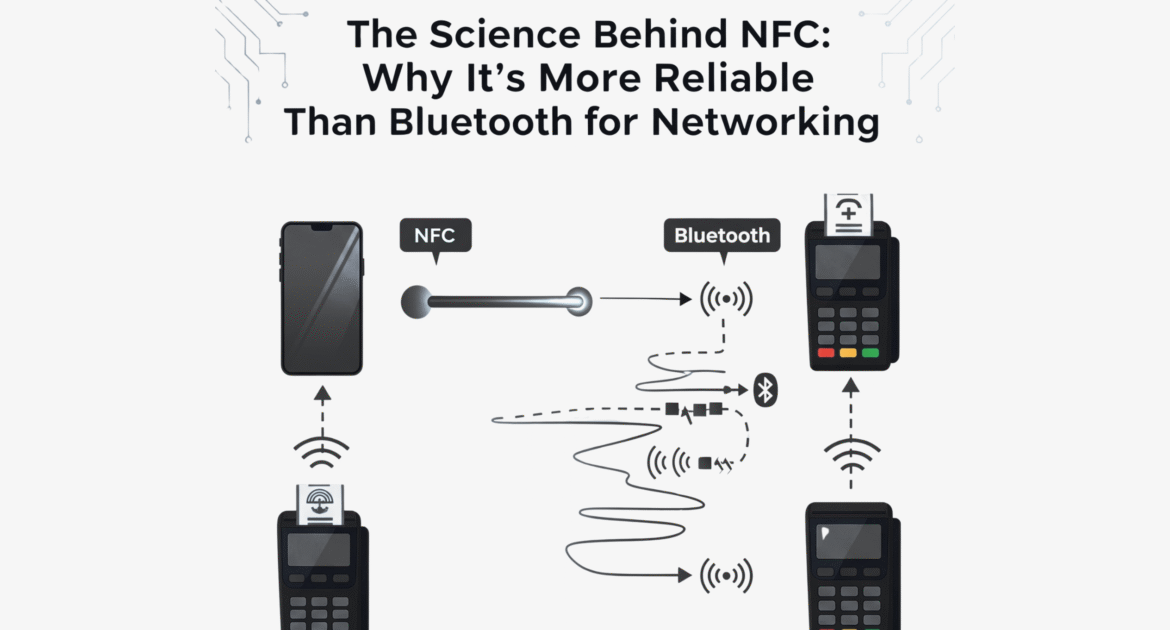
Both NFC and Bluetooth enable short-range wireless interactions, but they’re built for very different jobs. When the goal is to share a business profile instantly and predictably—at a booth, meeting, or event—NFC wins on reliability, intent, and user experience. Here’s the science behind why.
Physics & Range: Intentional Short Distance vs Ambient Radio
NFC (13.56 MHz, magnetic inductive coupling) works at a few centimetres. That tight range is a feature, not a bug: it forces a deliberate, contact-adjacent action (a tap), which reduces accidental triggers and ambiguity. Bluetooth (2.4 GHz, radiative RF) is designed for meters of range and continuous discovery, which is great for audio or peripherals—not for quick, consent-driven identity handoffs.
- NFC: Near-field coupling, predictable read window → consistent “tap → open” behavior.
- Bluetooth: Shared ISM band, variable RSSI, prone to interference in crowded venues.
Connection Model: Zero Pairing vs Negotiation
NFC launches content directly from a tiny chip (often just a URL). There’s no pairing, discovery, or passkey. Bluetooth typically requires device discovery, capability negotiation, and sometimes permissions—extra steps that add delay and failure points during fast networking moments.
- NFC: Single, deterministic action (tap) → instant content.
- Bluetooth: Multi-step flow (scan → select → pair/allow) → more user friction.
Power & Reliability: Passive Tags vs Battery Dependence
NFC tags are passive; they draw power from the reader’s field. No battery = nothing to charge, nothing to fail. Bluetooth sharers depend on the phone’s radio state (on/off), background permissions, and sometimes an app in the foreground, which can be inconsistent across OS versions.
Security Posture: Proximity = Natural Guardrail
Because NFC only works at very close range, it’s inherently consent-driven. Bluetooth’s longer range and background scanning are fantastic for audio handoff and wearables, but they raise more edge cases (accidental connections, noise in device lists) for quick, in-person introductions.
For a deeper look at safety myths and realities, see Is NFC Safe? Myths vs Facts.
Payload Fit: Tiny Trigger, Big Experience
Networking doesn’t require streaming data—just a fast pointer to your profile. NFC excels at this minimal, reliable payload (a URL) that opens a PWA-fast landing page where the real experience lives. Bluetooth’s strength (sustained throughput) is overkill for a “launch my profile now” use case.
UX Evidence: Tap → Open Beats “Find → Pair → Allow”
At events, speed and certainty drive conversions. A physical tap provides a clear affordance (“do this now”), triggers haptics on many devices, and lands users on your page within a second. Fewer steps = higher completion rates.
| Factor | NFC (Best for Networking) | Bluetooth (Great for Peripherals) |
|---|---|---|
| Typical Range | ~0–4 cm (intentional) | ~1–10 m (ambient) |
| Setup | No pairing, one tap | Discovery + pairing/perms |
| Power | Passive tag, no battery | Active radio, battery-dependent |
| Interference Sensitivity | Low in near-field | Higher in crowded 2.4 GHz |
| Best Payload | URL trigger → PWA profile | Sustained data streams |
| User Friction | Very low | Moderate |
How This Translates to Better Results
- Fewer failed shares: Tap is deterministic, even in noisy RF environments.
- Faster time-to-content: Immediate profile open boosts engagement.
- Higher perceived polish: Tap feels premium and purposeful.
See what an optimised profile experience looks like with a Digital Business Card and upgrade the physical touchpoint with the Smart NFC Business Card.
FAQs
Is NFC universally supported?
Most modern iPhones and Android phones support NFC reading. For older devices, always include a printed QR fallback on the card.
Is NFC more secure than Bluetooth?
For networking triggers (opening a profile), NFC’s very short range and user intent provide a strong practical security posture. For more, read Is NFC Safe? Myths vs Facts.
When is Bluetooth the better choice?
When you need sustained data transmission (e.g., audio streaming, wearables), for quick identity handoff, NFC is simpler and more reliable.
How does NFC actually work in a card?
A tiny passive chip stores a URL. The phone’s NFC reader energises the chip and opens your page. Learn more in How NFC Works in Business Cards.
Related read: Comparing media. See NFC vs QR Code Business Cards to decide your ideal mix. Then equip your team with Smart NFC Business Cards.